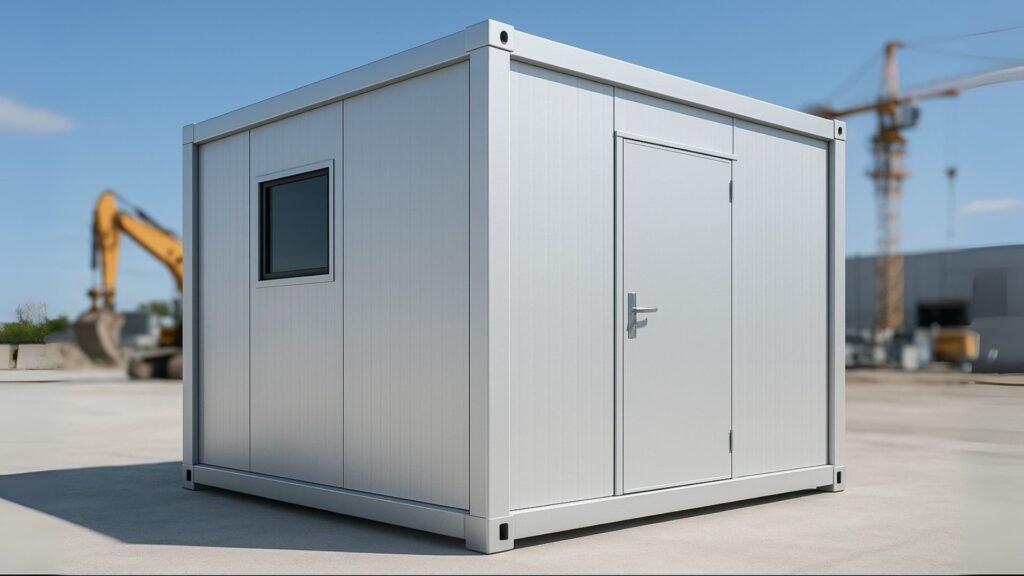

Price notice (July 2026): PKR figures below are indicative Pakistan market ranges for standard steel-frame porta cabins, office containers, and insulated sandwich panel upgrades across Lahore, Karachi, Islamabad, Faisalabad, and Multan. Steel, fuel, forex, panel density, sheet gauge, and city delivery change monthly. Prices may change without notice. Contact Al Rehmat Container Terminal for a written quotation valid on the day you order.
Buying a porta cabin in Pakistan is not only about size, delivery date, and the lowest WhatsApp quote. The real test starts after installation, when the cabin sits under direct summer sun, faces monsoon rain, carries AC load, and has staff working inside for eight to twelve hours a day. That is where porta cabin insulation Pakistan buyers must pay close attention.
A well-insulated porta cabin stays cooler, reduces AC running time, protects documents and equipment, controls condensation, and gives workers a more comfortable environment. A poorly insulated cabin becomes hot, noisy, humid, and expensive to maintain. The outside may look the same, but the difference between proper 50 mm PUF panels and low-grade EPS panels becomes clear in the first summer.
This guide explains the main insulation options used in Pakistani porta cabins, including PUF, EPS, rockwool, and glass wool. It also covers panel thickness, roof heat, floor insulation, fire safety, moisture resistance, and the exact specifications you should confirm before approving a quotation from any porta cabin manufacturer in Pakistan.
What Is Porta Cabin Insulation?
Porta cabin insulation is the material used inside wall, roof, and sometimes floor panels to reduce heat transfer between the outside environment and the cabin interior. In Pakistan, most quality cabins use insulated sandwich panels. These panels usually have two metal skins with an insulation core in the middle.
The insulation core decides how well the cabin performs in summer heat, humidity, and daily use. Two cabins can look almost identical from the outside, but one may stay workable with a 1.5-ton AC while the other feels hot even when the AC runs continuously.
Good insulation affects:
- Interior temperature during peak summer
- Air conditioner performance and electricity cost
- Staff comfort and productivity
- Moisture and condensation control
- Noise reduction on busy construction sites
- Panel strength and dent resistance
- Fire safety and electrical risk management
- Long-term durability after relocation
For site offices, labour camps, sales cabins, guard rooms, portable washrooms, and prefab homes, insulation should be treated as a core specification, not a luxury add-on.
Best Insulation for Porta Cabins in Pakistan
The best insulation for most porta cabins in Pakistan is PUF sandwich panel insulation, especially for site offices, labour accommodation, control rooms, sales cabins, and any cabin using air conditioning. PUF performs better than EPS in heat, handles moisture more reliably, and helps reduce cooling load in cities like Lahore, Karachi, Multan, Sukkur, Faisalabad, and Islamabad.
EPS can still work for temporary storage cabins, shaded guard huts, and low-budget non-AC spaces. Rockwool is useful where fire resistance is the main priority. The right answer depends on how the cabin will be used, where it will be installed, and how long the project will run.
Why Insulation Matters More in Pakistan’s Climate
Pakistan’s weather puts heavy pressure on portable buildings. In summer, steel surfaces heat quickly. Roof panels receive direct solar radiation for hours. If the wall and roof panels are weak, heat transfers into the cabin faster than the AC can remove it.
In Lahore, Faisalabad, Multan, Bahawalpur, and Sukkur, summer heat can make under-insulated cabins uncomfortable after midday. In Karachi and coastal Sindh, humidity adds another challenge. Moist air can enter weak joints, damage panel bonding, and create condensation inside the cabin. Islamabad, Rawalpindi, Murree-linked projects, and northern areas need insulation that helps with both summer cooling and winter warmth.
A properly insulated cabin helps solve several issues at once:
- Slower heat transfer from walls and roof
- Better AC cooling cycle
- Lower hot spots near ceiling level
- Less condensation around corners and joints
- More stable indoor temperature
- Better long-term condition after transport and relocation
If your cabin will be used by people daily, insulation quality directly affects comfort, productivity, and ownership cost.
PUF Panels for Porta Cabins
PUF stands for polyurethane foam. It is one of the most common premium insulation materials used in high-quality porta cabins, office containers, prefabricated homes, and cold-chain buildings.
A PUF sandwich panel is made by placing polyurethane foam between two metal sheets. The foam expands and bonds with the skins, creating a rigid composite panel. This gives the panel strength, insulation value, and better resistance to moisture compared with many low-cost alternatives.
Benefits of PUF Insulation
PUF is popular for insulated porta cabin Pakistan projects because it performs well in heat and daily-use conditions. It is suitable for construction site offices, manager cabins, labour camp rooms, medical units, control rooms, security cabins, sales offices, and portable accommodation.
Main advantages include:
- Strong thermal insulation for Pakistan summer
- Better AC efficiency compared with EPS
- Closed-cell structure that resists moisture
- Rigid panel strength for walls and roof
- Lower chance of panel sagging and soft spots
- Improved comfort for full-day office use
- Better long-term value for relocatable cabins
For most commercial and construction projects, PUF is the safest default choice if the budget allows it.
When PUF Is Worth the Extra Cost
PUF should be strongly considered when:
- The cabin will be used as a daily site office
- The cabin will have AC installed
- The cabin will sit in direct sunlight
- The project duration is more than six months
- Staff will work or sleep inside the unit
- The site is in a hot or humid city
- The cabin may be relocated and reused
- The cabin stores IT equipment, drawings, files, or sensitive material
If one quotation is much cheaper than another, check whether the supplier is using PUF, EPS, or an unspecified “insulated panel.” The cheapest quote often hides thinner panels, lower density, or weaker electrical scope.
EPS Panels for Porta Cabins
EPS stands for expanded polystyrene. In Pakistan, many buyers know it as thermopore. It is lightweight, affordable, and widely available. EPS is used in low-cost sandwich panels, temporary rooms, storage spaces, and budget cabins.
EPS can reduce heat compared with uninsulated tin or bare steel, but it does not perform as well as PUF in extreme summer conditions. It is usually better for temporary, shaded, lightly used, or non-AC spaces.
When EPS Can Be Acceptable
EPS may be acceptable for:
- Short-term storage cabins
- Tool rooms
- Basic guard cabins under shade
- Low-occupancy spaces
- Projects with very tight budgets
- Non-AC utility cabins
- Temporary structures used for a few months only
EPS is not useless. The issue is using it in the wrong application. If the cabin is expected to work as a full-day site office in May, June, July, or August, EPS may disappoint the buyer.
Risks of EPS for Office Use
For daily office use, EPS may lead to:
- Higher AC running time
- Warmer interiors in afternoon heat
- Lower panel strength
- More risk of dents and surface damage
- Reduced staff comfort
- Possible moisture-related performance loss
- Lower long-term durability after relocation
If EPS is selected, ask for panel thickness, density, joint sealing, roof treatment, and warranty in writing.
PUF vs EPS Sandwich Panels Pakistan: Quick Comparison
| Feature | PUF Panels | EPS Panels |
|---|---|---|
| Best use | Offices, accommodation, AC cabins, long-term projects | Storage, shaded guard huts, short-term budget cabins |
| Heat control | Strong | Basic to moderate |
| AC efficiency | Better cooling retention | Higher cooling loss |
| Moisture resistance | Good closed-cell performance | Depends on quality and sealing |
| Panel strength | More rigid and dent resistant | Lighter and softer |
| Upfront cost | Higher | Lower |
| Long-term value | Better for daily use | Good only for limited applications |
For buyers comparing EPS vs PUF sandwich panels Pakistan, the main question is not “which is cheapest?” The better question is “which panel matches the use of the cabin?” If people will work, sleep, or meet clients inside the cabin, PUF is usually the better investment.
Rockwool and Glass Wool Insulation
Rockwool and glass wool are fibrous insulation materials. They are different from PUF and EPS foam panels. Their biggest advantage is fire resistance and acoustic performance. Rockwool is often used where fire safety is more important than maximum cooling efficiency.
For porta cabins, rockwool may be useful in:
- Electrical control rooms
- Generator support cabins
- Industrial monitoring rooms
- Sites with stricter fire safety requirements
- High-risk equipment cabins
However, fibrous insulation must be installed properly. If it becomes wet or poorly enclosed, its performance can suffer. For standard office cabins, PUF usually gives better thermal performance for the same wall thickness. For fire-rated applications, rockwool should be discussed with the manufacturer during specification.
50 mm vs 75 mm vs 100 mm Panels
Many buyers only ask whether the cabin has PUF or EPS, but panel thickness is equally important. A good quotation should clearly mention thickness in millimetres.
50 mm PUF Panels
A 50 mm PUF panel is a common specification for standard site offices and portable cabins in Pakistan. It can work well for regular office use if the cabin has proper roof treatment, sealed joints, and correctly sized AC.
Best for:
- Standard site offices
- Security cabins
- Sales cabins
- Temporary project offices
- Moderate climate zones
75 mm PUF Panels
A 75 mm PUF panel is better for hotter locations, long working hours, labour accommodation, and cabins exposed to direct sun all day. It improves comfort and reduces cooling load.
Best for:
- Labour accommodation
- Remote site offices
- Karachi humidity-sensitive projects
- Multan, Sukkur, Bahawalpur, and interior Sindh sites
- Long-duration projects
100 mm PUF Panels
A 100 mm panel is usually used for higher-performance requirements, residential-style prefab rooms, special equipment spaces, and extreme temperature applications.
Best for:
- Prefab homes
- Long-term accommodation
- Cold-sensitive storage
- High-spec control rooms
- Extreme climate locations
For standard commercial buyers, 50 mm PUF is the practical minimum. For comfort-focused or long-term projects, 75 mm is often a better choice.
Roof Insulation Is the Biggest Comfort Factor
The roof is usually the hottest surface of a porta cabin. Direct sunlight hits it for hours, and heat transfers downward into the cabin. Many buyers focus on wall panels but ignore roof insulation, which is a major mistake.
A good roof specification should include:
- Insulated roof panels
- Proper slope or camber for rainwater drainage
- Sealed joints to stop leakage
- Weather-rated exterior coating
- Optional reflective finish for high-heat areas
- False ceiling or air gap for premium comfort
If your cabin feels hot even with AC running, the roof is often the reason. Heat enters from above faster than the AC can remove it, especially when the roof panel is thin or poorly sealed.
Floor Insulation and Raised Installation
Floor insulation is not always included in standard porta cabin quotes, but it can matter in specific use cases. Cabins placed above ground may experience heat, dust, moisture, or cold air movement from below. In northern areas, floor insulation helps retain warmth. In hot regions, a properly built floor improves comfort and durability.
At minimum, the cabin should be placed on a level base with enough ground clearance to avoid standing water. For monsoon-prone sites, raising the cabin on concrete blocks or a prepared pad protects the base frame from corrosion.
A good floor system may include:
- Steel base frame
- Anti-rust coating
- Marine plywood or suitable board
- Vinyl, laminate, or ceramic finish
- Optional floor insulation for higher-spec units
Ask the manufacturer what is included in the floor build, especially if the cabin will be relocated multiple times.
Moisture, Condensation, and Monsoon Protection
In Pakistan, insulation is not only about heat. Monsoon rain, humidity, and condensation can damage weak cabins. Poorly sealed joints allow water and air leakage. When warm humid air meets a cool AC interior surface, condensation can form.
Moisture problems may appear as:
- Damp smell inside the cabin
- Rust near joints or base frame
- Water stains on panels
- Swollen flooring
- AC working harder than normal
- Mold around corners
- Panel bubbling or delamination
To reduce these risks, ask about panel joint sealing, roof slope, door seals, window flashing, anti-corrosion coating, and drainage. In Karachi and coastal projects, these details are especially important.
Fire Safety and Electrical Planning
Every porta cabin should be treated as an occupied structure, not just a temporary box. Fire safety matters because cabins usually include electrical wiring, DB panels, lights, fans, AC points, computers, chargers, and sometimes pantry appliances.
Before approving a quote, confirm:
- Electrical load calculation
- Distribution board and breakers
- Proper earthing provision
- AC wiring sized correctly
- Safe cable routing
- Quality switches and fittings
- Fire extinguisher location
- Clear exit path
- Fire-retardant insulation where required
PUF, EPS, and rockwool have different fire behaviours. Rockwool generally performs best for fire resistance. PUF can be supplied in fire-retardant grades. EPS should be used carefully in occupied or high-risk spaces. Always confirm the fire rating in writing when the cabin will be used by staff.
How Insulation Affects AC Performance
A porta cabin with weak insulation forces the AC to run longer. The room may cool for a short time, then heat quickly as soon as the compressor cycles off. This increases electricity cost and reduces AC life.
Good insulation helps the AC reach the set temperature faster and maintain it with less effort. For many standard site offices, a 1.5-ton split AC is common, but AC sizing depends on size, sun exposure, occupancy, equipment heat, insulation thickness, roof treatment, and door opening frequency.
For an 8×20 site office with regular staff use, insulation quality can decide whether one AC performs comfortably or struggles all afternoon.
For detailed office layouts and AC-ready units, see our Office Container Pakistan service page.
City-by-City Insulation Recommendations
| City / Region | Main Climate Issue | Recommended Insulation Approach |
|---|---|---|
| Lahore | Summer heat, dust, monsoon rain | 50 mm PUF minimum, sealed roof joints, AC-ready electrical |
| Karachi | Humidity, coastal corrosion, heat | PUF panels, anti-rust coating, strong joint sealing, roof drainage |
| Islamabad / Rawalpindi | Summer heat and winter cold | PUF walls and roof, sealed doors and windows |
| Multan / Bahawalpur / Sukkur | Extreme summer heat | 75 mm PUF preferred for offices and accommodation |
| Faisalabad / Gujranwala / Sialkot | Industrial dust and daily use | PUF panels, durable flooring, strong doors and window seals |
| Northern areas | Cold nights and winter comfort | PUF walls, roof and optional floor insulation |
For nationwide cabin planning, Al Rehmat also provides logistics transport Pakistan support for site delivery and placement.
Best Insulation by Use Case
Construction Site Offices
For construction site offices, PUF is usually the best choice. These cabins are used daily by project managers, engineers, QS teams, and supervisors. They often contain laptops, drawings, printers, and AC units. Weak insulation increases heat, dust discomfort, and power cost.
Labour Accommodation
For labour camp accommodation, PUF is strongly recommended. Better insulation improves sleeping conditions, reduces heat stress, and supports worker welfare. For large camp layouts, 75 mm PUF should be considered where budget allows.
Related service: prefabricated homes in Pakistan.
Security Guard Cabins
EPS may work for shaded, short-duty guard cabins. PUF is better for exposed gates, 24-hour duty, and locations where guards sit through afternoon heat.
Portable Washroom Cabins
For washroom cabins, moisture-resistant materials, ventilation, plumbing quality, and easy-clean finishes matter along with insulation. See our portable washroom cabins for site sanitation options.
Storage Cabins
EPS may be acceptable if the items are not heat-sensitive. For documents, electronics, chemicals, samples, or sensitive stock, PUF is a safer choice.
How to Compare Two Porta Cabin Quotes
Do not compare only the final price. A cheaper quote may include thinner steel, weaker insulation, fewer electrical points, no AC provision, basic flooring, and ex-factory delivery only.
Ask each supplier these questions:
- What insulation core is used: PUF, EPS, rockwool, or glass wool?
- What is the panel thickness in millimetres?
- What is the panel skin gauge?
- What is the insulation density?
- Is the roof also insulated?
- Are panel joints sealed against rain and air leakage?
- Is the floor insulated or only boarded?
- What anti-rust treatment is used on the steel frame?
- Is electrical wiring included?
- Is AC wiring included or quoted separately?
- Is delivery included to the exact site?
- Is crane offload included?
- What warranty or after-sales support is available?
- Can the cabin be relocated later?
- Are production photos or inspection available before dispatch?
A professional manufacturer should answer these clearly. If the answer is only “standard quality,” ask for written specifications before paying advance.
Indicative Insulation Upgrade Cost Impact
| Specification | Typical Use | Cost Impact | Buyer Note |
|---|---|---|---|
| EPS panel | Storage or basic shaded cabin | Lowest upfront cost | Not ideal for full-day AC office use |
| 50 mm PUF panel | Standard site office | Medium cost | Practical minimum for most offices |
| 75 mm PUF panel | Hot cities and accommodation | Higher cost | Better comfort and lower cooling load |
| Rockwool panel | Fire-sensitive applications | Project-specific | Use where fire resistance is priority |
For full cost planning, read our porta cabin price in Pakistan guide.
Why Factory Quality Matters
Even the best insulation material can fail if manufacturing quality is poor. Panel fit, welding, sealing, paint, door alignment, window installation, and electrical work all affect performance.
A reliable manufacturer checks:
- Weld quality
- Panel joint alignment
- Roof drainage
- Door and window sealing
- Electrical safety
- Paint and anti-rust treatment
- Final finishing before dispatch
Factory-controlled work usually performs better than rushed on-site fabrication because material handling, tools, and quality checks are managed in one place.
Al Rehmat Container Terminal manufactures porta cabins, office containers, portable washrooms, prefab units, and modular site infrastructure under one service range. View all options on Our Services.
When Should You Upgrade Insulation?
Upgrade insulation if:
- The cabin will be used for more than one year
- Staff will work inside full-time
- The cabin is placed in direct sun
- The site is in a very hot city
- The cabin includes computers or sensitive equipment
- It will be used for accommodation
- You want to relocate and reuse the cabin
- Electricity cost is a concern
- The cabin is client-facing, such as a sales office
The insulation upgrade often pays back through better usability, lower cooling load, fewer complaints, and longer service life.
Final Recommendation
For most Pakistani buyers, PUF sandwich panel insulation is the best default choice for porta cabins used as offices, accommodation, sales cabins, control rooms, and staff spaces. EPS has a place in low-cost temporary storage or shaded light-duty cabins, while rockwool is useful where fire performance is the main requirement.
The smartest way to buy is to match insulation to the use case. Do not ask only for “porta cabin price.” Ask for the full specification: insulation type, panel thickness, roof treatment, joint sealing, steel frame, electrical load, AC provision, delivery, and warranty.
Al Rehmat Container Terminal manufactures insulated porta cabins, office containers, portable washrooms, prefab homes, and site infrastructure for projects across Pakistan. Share your city, required size, usage, and handover date to receive a practical specification and delivered quotation for your site.
Next steps: Contact Al Rehmat Container Terminal for a spec-based quote you can compare side by side with other suppliers.
Frequently Asked Questions About Porta Cabin Insulation
PUF sandwich panel insulation is usually the best choice for porta cabins in Pakistan, especially for offices, labour accommodation, control rooms, and AC-equipped cabins. It performs better in heat and gives stronger long-term value than basic EPS panels.
Yes. PUF generally provides better thermal insulation, moisture resistance, and panel strength than EPS. EPS is cheaper and can work for storage or shaded temporary cabins, but PUF is better for daily-use offices and accommodation.
A 50 mm PUF panel is commonly used for standard site offices in Pakistan. For hotter cities, long working hours, labour accommodation, and direct-sun locations, 75 mm PUF is a better option.
Yes, EPS can be used in low-budget temporary cabins, storage cabins, and shaded guard huts. It is not the best choice for full-day air-conditioned offices or long-term accommodation in hot Pakistani cities.
Yes, poorly insulated porta cabins can become very hot in summer. Proper PUF wall and roof panels, sealed joints, reflective roof treatment, and correctly sized AC help keep the cabin comfortable.
Use PUF insulated wall and roof panels, seal all joints, choose proper roof slope and coating, raise the cabin above wet ground, install the right AC size, and avoid placing the cabin where heat reflects from walls or concrete all day.
For many standard site offices, 50 mm PUF is a practical minimum. If the cabin is in extreme heat, used for accommodation, or occupied for long hours, 75 mm PUF should be considered.
Good insulation helps the AC cool faster and maintain temperature with less effort. This can reduce electricity use compared with weakly insulated cabins where the AC runs continuously.
Rockwool is better for fire resistance, while PUF is usually better for thermal insulation in standard porta cabin office use. The right choice depends on whether comfort cooling or fire performance is the main priority.
You can request a written quotation from Al Rehmat Container Terminal. Share your city, cabin size, usage, AC requirement, and delivery timeline for a spec-based quote.