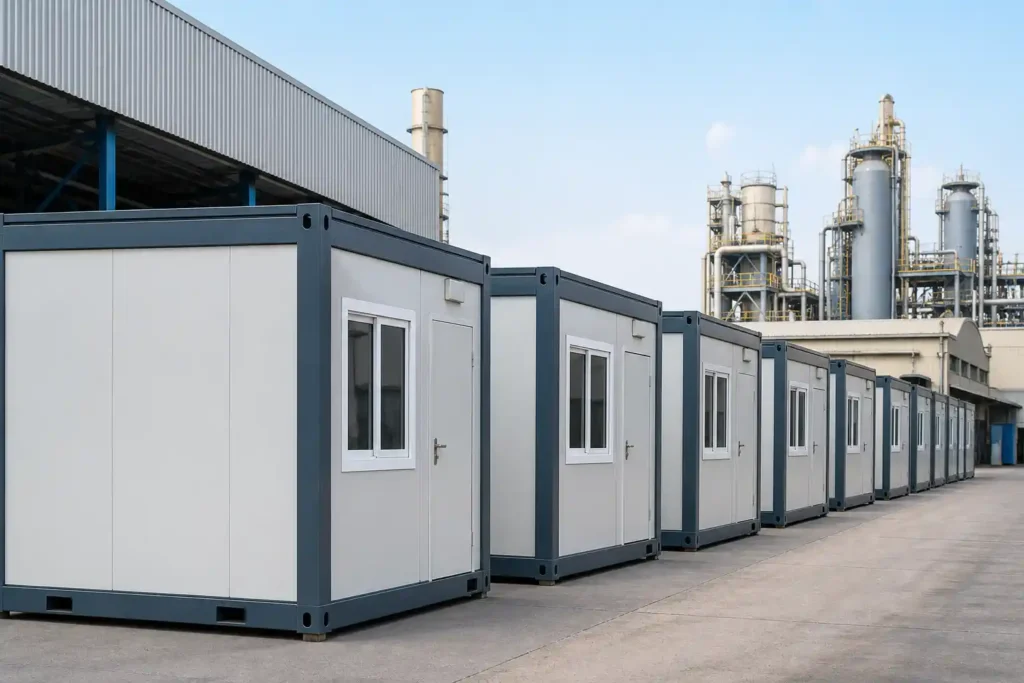

Modular solutions industrial infrastructure is changing how factories, logistics yards, construction camps, and industrial estates set up working facilities in Pakistan. Industrial growth no longer waits for slow brick construction. Businesses need speed, predictable cost, quality control, and the ability to expand or relocate when operations change.
That is why modular solutions industrial infrastructure models are becoming the preferred choice for site offices, workforce housing, security posts, washrooms, storage, and temporary industrial support buildings. Instead of pouring concrete walls and waiting months for site facilities, companies can deploy factory-built units in weeks and keep projects moving.
This guide explains why modular systems are the future of industrial infrastructure in Pakistan, which industries benefit most, how modular compares with conventional construction, and how to plan a practical modular package for Lahore, Karachi, Islamabad, Faisalabad, Multan, Gujranwala, Sialkot, and other industrial cities.
What Are Modular Solutions for Industrial Infrastructure?
Modular solutions are factory-built structures designed for fast delivery, controlled quality, and flexible deployment. In industrial settings, they include:
- Porta cabins for site and factory offices
- Office containers for project and admin teams
- Labour camp and staff accommodation modules
- Portable washroom cabins
- Security guard cabins
- Storage containers for tools and inventory
- Prefabricated homes and dormitory blocks
- Linked modular camps for large industrial projects
These units are manufactured off-site with steel frames, insulated panels, electrical provisions, and custom layouts. On site, they are placed, leveled, connected to utilities, and put into use quickly.
For a full product range, see Our Services.
Why Modular Solutions Industrial Infrastructure Is Growing Fast
Pakistan’s industrial environment is changing. New factories, warehouses, housing schemes, road projects, power jobs, and export-linked facilities need faster mobilization. Traditional temporary buildings are too slow and often too rigid for modern project cycles.
Modular solutions industrial infrastructure demand is rising because companies face:
- Tighter project deadlines
- Higher labour and material costs
- Need for relocatable assets
- Remote and semi-remote project locations
- Pressure to reduce site waste
- Demand for better worker welfare facilities
- Need for scalable expansion without rebuilding
In this environment, modular systems give industrial buyers a practical advantage: faster readiness with better cost control.
Speed: Industrial Projects Cannot Wait Months for Site Facilities
One of the strongest reasons modular solutions industrial infrastructure will dominate future projects is deployment speed.
Factory-built porta cabins and office containers can typically be manufactured in 2 to 4 weeks for standard units, then delivered and placed quickly. Brick site offices and temporary masonry facilities often take much longer because of civil work, curing, plaster, wiring, and finishing delays.
Faster setup helps industrial teams:
- Start project management earlier
- Secure the site with gate cabins from day one
- Provide washrooms and welfare facilities on time
- Store tools and materials safely
- Open sales or admin offices without waiting for permanent buildings
When a project clock is running, modular readiness protects progress.
Cost Control and Predictable Budgeting
Industrial buyers need cost certainty. Modular units offer clearer line-item pricing for size, insulation, electrical, delivery, and upgrades. That makes budgeting easier than open-ended temporary civil construction.
Compare the planning logic:
| Factor | Modular Units | Conventional Temporary Build |
|---|---|---|
| Lead time | Weeks for standard units | Often months |
| Cost clarity | Factory quote with specs | Variable labour and material overruns |
| Relocation | Possible | Usually permanent loss |
| Quality control | Factory QA | Site-dependent |
| Expansion | Add more units | New civil work required |
| Residual value | Asset can move or resell | Low residual after demolition |
For ownership cost planning, review porta cabin price in Pakistan and porta cabin vs brick construction cost.
Quality Control: Factory Build Beats Rushed Site Work
Industrial facilities need reliable structures. Modular manufacturing happens in controlled conditions where welding, panel fit, electrical layout, and finishing can be checked before dispatch.
This matters for:
- Steel frame strength
- Insulation thickness and sealing
- Door and window alignment
- Electrical safety
- Roof drainage and weather protection
- Consistent quality across bulk orders
A factory-built porta cabin manufacturer process reduces the risk of weak site workmanship that often appears in temporary brick rooms.
Flexibility and Relocation for Changing Industrial Needs
Industrial operations change. A factory expansion may move from civil phase to production phase. A logistics yard may shift storage zones. A construction camp may relocate along a highway corridor.
Modular solutions industrial infrastructure supports that flexibility. Units can be relocated, reconfigured, or expanded with additional modules.
Examples:
- Move site offices when the project phase changes
- Shift labour camp cabins to the next package
- Reuse security cabins across housing society gates
- Expand admin space by adding linked office units
- Convert storage needs with 20ft or 40ft containers
This relocatable value is one reason modular systems outperform fixed temporary construction.
Scalability for Industrial Growth
Future industrial infrastructure must scale. Modular systems allow phased growth without redesigning everything.
A practical growth path looks like this:
- Start with a compact site office and security cabin
- Add washrooms and storage as manpower increases
- Add labour accommodation for remote operations
- Expand into multi-room office containers for larger teams
- Add prefab dormitories or staff housing for long projects
This phased model protects cash flow and matches real operational demand.
Useful supporting pages:
- Office Container Pakistan
- Portable Washroom Cabin Pakistan
- Storage Container Pakistan
- Prefabricated Homes Pakistan
Better Site Impact and Lower Waste
Industrial buyers are paying more attention to efficiency and site impact. Modular construction reduces on-site material waste, fewer wet trades, and less debris compared with temporary masonry.
Benefits include:
- Less construction waste on active industrial sites
- Fewer materials stored and damaged on site
- Cleaner mobilization around operating factories
- Reusable assets instead of demolish-and-dispose temporary rooms
For busy industrial yards in Faisalabad, Gujranwala, Karachi, and Lahore, lower disruption matters as much as speed.
Climate-Ready Modular Design for Pakistan
Pakistan industrial sites face heat, dust, humidity, monsoon rain, and coastal corrosion in some cities. Modular units can be specified for these conditions with insulated sandwich panels, sealed joints, anti-rust coatings, and AC-ready electrical layouts.
For occupied offices and accommodation, insulation quality is critical. Many industrial buyers now prefer PUF panels for better cooling performance. See porta cabin insulation Pakistan for panel guidance.
City-focused planning notes:
- Lahore: heat, dust, monsoon sealing
- Karachi: humidity and anti-corrosion priority
- Islamabad / Rawalpindi: rain protection and winter comfort
- Multan / Sukkur: stronger insulation for extreme heat
- Faisalabad / Sialkot: durable flooring and industrial-use hardware
Industries That Benefit Most from Modular Infrastructure
Construction and Infrastructure
Contractors need site offices, washrooms, guard cabins, and storage from day one. Modular units open the site faster and support phased delivery. Related guide: plan construction project porta cabins.
Manufacturing and Factory Expansion
Factories use modular offices for supervisors, QA teams, contractor staff, and temporary expansion during plant upgrades.
Logistics and Warehousing
Yards need secure storage containers, gate cabins, and admin offices near loading zones. Modular units fit active logistics operations without major civil disruption.
Oil, Gas, Power, and Remote Camps
Remote projects need relocatable camps, accommodation, washrooms, and control rooms. Modular systems travel with the project.
Real Estate and Industrial Parks
Developers use sales cabins, security posts, and temporary admin offices while permanent buildings are under construction.
Export Processing and Cold Chain Support
Industrial cold chain and port-linked operations also need modular offices and staging support. Where temperature-sensitive cargo is involved, see Shipping & Reefer Container Services Pakistan.
Modular vs Conventional Industrial Site Buildings
| Decision Point | Why Modular Wins |
|---|---|
| Project start date is tight | Faster factory production and delivery |
| Site may relocate | Units can move with the project |
| Budget needs transparency | Clear specs and delivered quotes |
| Quality must be consistent | Factory QA across bulk units |
| Future expansion is likely | Add modules instead of rebuilding |
| Worker welfare is required early | Washrooms and camps deploy quickly |
Conventional construction still has a place for permanent long-life buildings. But for industrial support infrastructure and temporary-to-semi-permanent facilities, modular is usually the smarter operating decision.
What a Future-Ready Modular Industrial Package Includes
A complete modular solutions industrial infrastructure package often includes:
- Site or factory office cabin
- Security cabin at entry
- Portable washrooms for staff and contractors
- Storage container for tools and materials
- Labour camp or staff accommodation where needed
- Delivery, placement, and utility connection planning
Indicative planning ranges:
- Security cabin: from about PKR 175,000
- Compact office cabin: from about PKR 400,000
- Standard 8×20 office: from about PKR 650,000
- Portable washroom single unit: from about PKR 175,000
- 20ft storage container: from about PKR 280,000 to 450,000+ by grade
Always request a line-item delivered quotation with insulation, electrical, and offload details.
How to Choose Modular Units for Industrial Use
Before ordering, confirm:
- Exact use case: office, camp, washroom, storage, security
- Staff count and shift pattern
- Project duration and relocation plan
- Insulation type and thickness
- Steel frame and anti-rust treatment
- Electrical load and AC provision
- Water and drainage for washrooms
- Delivery city and crane access
- Warranty and after-sales support
- Layout drawing approval before fabrication
Use the supplier checklist in our best porta cabin manufacturer guide.
Logistics Is Part of the Modular Advantage
Industrial modular success depends on delivery planning as much as manufacturing. Oversize modules, crane offload, route access, and placement timing must be coordinated.
Al Rehmat supports factory-to-site movement through logistics transport Pakistan, helping industrial clients reduce handoffs between manufacturing and transport teams.
Why Al Rehmat Container Terminal Supports Future Industrial Infrastructure
Al Rehmat Container Terminal manufactures and supplies modular industrial support systems across Pakistan, including:
- Porta cabins for offices and camps
- Office containers for industrial admin teams
- Portable washroom cabins
- Storage containers
- Prefabricated homes and dormitory modules
- Nationwide delivery and placement support
This integrated approach helps industrial buyers deploy complete site infrastructure from one partner instead of managing multiple disconnected suppliers.
Final Recommendation
Modular solutions industrial infrastructure is the future because industrial projects need speed, flexibility, cost control, and relocatable value. Factory-built porta cabins, office containers, washrooms, storage units, and camp modules give companies usable facilities faster than temporary brick construction, with better quality control and easier expansion.
For Pakistan’s factories, logistics yards, construction camps, and industrial estates, modular is no longer a temporary compromise. It is a practical operating strategy.
Next steps: Contact Al Rehmat Container Terminal with your city, facility list, staff count, and handover date for a modular industrial infrastructure quotation.
Frequently Asked Questions
Because industrial projects need faster setup, clearer cost control, relocatable assets, and scalable facilities. Modular units deploy quicker than temporary brick buildings and can move when operations change.
Common units include porta cabins, office containers, security cabins, portable washrooms, storage containers, labour camp modules, and prefabricated accommodation blocks.
Often yes on total project cost, especially when speed, relocation value, and reduced site waste are included. Always compare delivered quotes with matching specifications.
Yes. Properly built steel-frame porta cabins and containers can be relocated when framed, sealed, and transported correctly.
Yes. Factories and warehouses use modular offices, gate cabins, contractor rooms, washrooms, and secure storage during expansion and daily operations.
Standard porta cabins and office containers often take 2 to 4 weeks to manufacture, plus delivery and placement. Custom multi-room packages may take longer.
For AC offices, 50 mm PUF is a practical minimum. Hotter cities and long-occupancy rooms may benefit from 75 mm PUF.
Yes. Portable washrooms and labour camp modules help industrial and construction sites provide sanitation and accommodation faster than permanent facilities.
Yes. Al Rehmat Container Terminal supports delivery and placement across Lahore, Karachi, Islamabad, Faisalabad, Multan, Rawalpindi, Peshawar, Gujranwala, Sialkot, and other cities.
Share your city, required units, staff count, and timeline with Al Rehmat Container Terminal for a written modular package quotation.